You Fall Asleep Fine.
Then 3 AM Arrives.
And You're Wide Awake. Every Night.
The 14-day circadian reset protocol designed for adults 60+ who wake early and can't fall back asleep, without medication, sleep aids, or changing your bedtime earlier.
Get the 14-Day Protocol, $9This is Step 1 of the Functional Independence System.
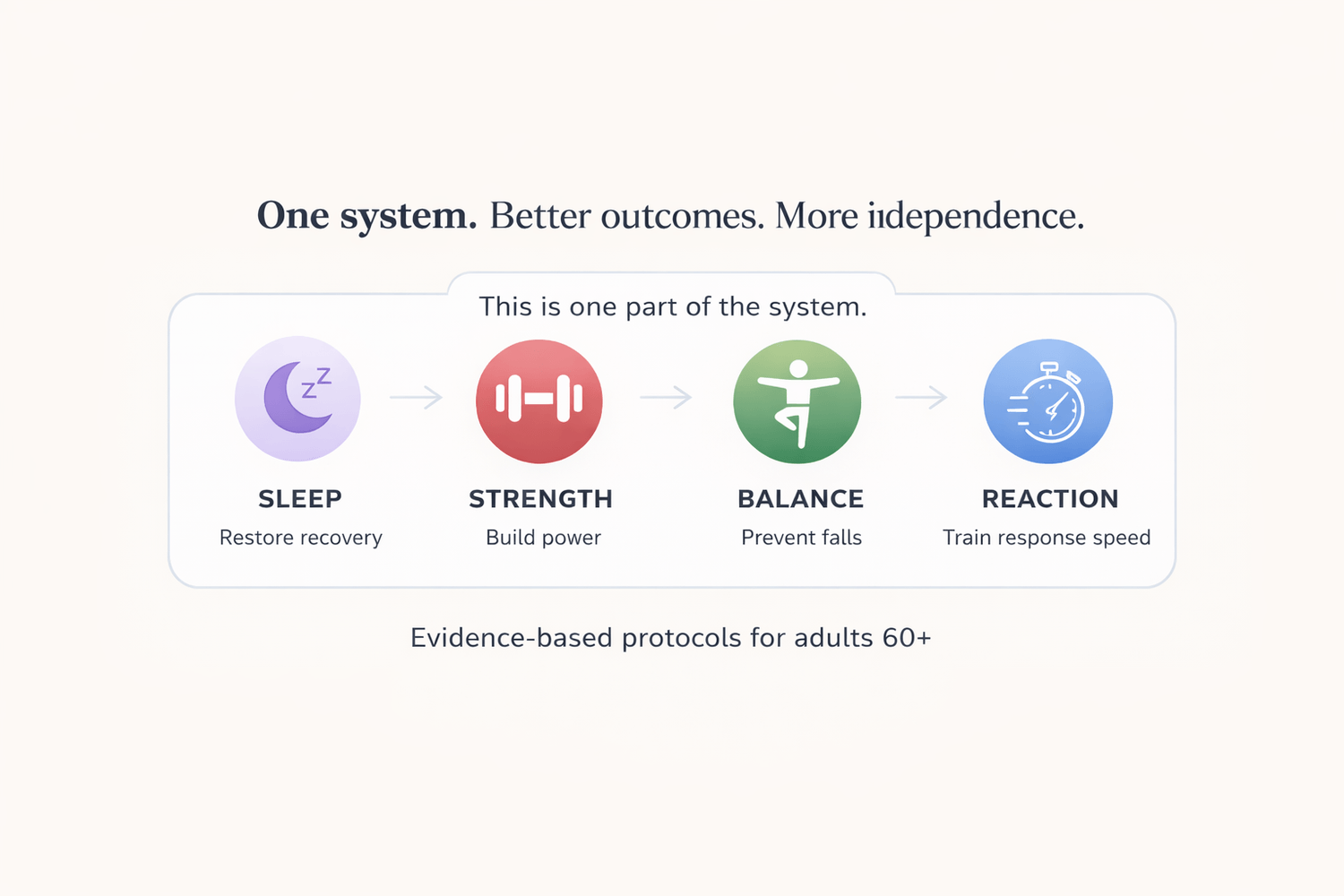
Sleep restores recovery. Strength rebuilds power. Balance stabilizes movement. Reaction prevents mistakes.
Improve one and everything improves. Start with sleep.
This is not insomnia.
It's a timing problem.
After 60, most people don't struggle to fall asleep. They fall asleep fine, then wake between 3 and 4 AM and can't get back to sleep.
That's not a sleep disorder. That's a circadian shift. And those two things require completely different responses.
Insomnia is difficulty falling asleep. That requires one approach.
Early waking is your circadian clock shifting 1 to 2 hours earlier with age. That requires a different one entirely.
Most people apply the wrong fix. They go to bed earlier. That makes it worse.
Left uncorrected, early waking reduces deep sleep, the phase responsible for physical recovery, memory consolidation, and muscle repair. Over time, this affects strength, balance, and independence.
What's actually happening
Your brain has a master clock called the suprachiasmatic nucleus (SCN). It coordinates when you feel sleepy, when cortisol rises, and when body temperature drops. After 60, the SCN loses sensitivity. Its signals weaken. The timing window for deep sleep shrinks and shifts earlier.
Your body starts winding down at 8 or 9 PM instead of 10 or 11. Deep sleep runs its course by 3 AM. You wake up not because something is wrong, but because your clock says morning.
The fix is not earlier sleep. The fix is retraining the system that sets the timing.
Research from Harvard's Division of Sleep Medicine and decades of circadian rhythm studies confirm that light timing is the primary tool for resetting the internal clock in older adults.
This protocol is built around that research. It gives you the exact schedule, daily actions, and 14-day progression to retrain your clock without medication.
Everything in the protocol
This is what you'll use to fix early waking in 14 days:
Clinical light exposure schedule
Hour-by-hour timing from morning through night. Light timing matters more than intensity. This page tells you exactly when and how.
14-day reset plan with daily checkpoints
Four progressive phases with specific actions for each day. Measurable signals at Day 7 tell you whether the protocol is working.
Troubleshooting guide for the 5 most common problems
Still waking at 3 AM? Can't fall asleep? Waking before sunrise? Each problem has a specific fix covered in detail.
Medications that quietly disrupt sleep
8 common medication classes that interfere with sleep architecture, and the exact questions to ask your doctor.
14-day sleep tracking worksheet
Track wake time, light exposure, bedtime, and quality every day. Bring it to your doctor if sleep doesn't improve after 4 weeks.
Daily Execution Checklist
One page. Print it. Put it somewhere visible. Six items, every morning. The protocol only works if you follow it consistently.
THE SYSTEM YOU'RE ENTERING
This is not sleep hygiene advice.
It's a timing reset.
It targets the root cause
Not the symptom. The 3 AM wake-up is a downstream effect of circadian misalignment. This protocol corrects the alignment.
It works with your biology
After 60, your clock shifts earlier. Fighting it doesn't work. This protocol uses that shift to your advantage.
It produces measurable results
Most people notice a shift by Day 7. The tracking worksheet shows you exactly what's changing and when.
What happens day by day
"I've had this exact problem for two years. Tried going to bed earlier, tried melatonin. Nothing worked. The idea that I was reinforcing the problem by sleeping earlier hit hard."
"3 AM, every single night. My doctor just said it was normal aging. Good to finally understand why it's happening."
Reader comment, 2026
"The sleep article got me. 44,000 other people found it too. There's clearly something here the standard advice misses."
Reader comment, 2026
Who this is for, and who it is not for
This protocol addresses circadian timing. It is not a treatment for sleep disorders.
Not suitable for
- Diagnosed sleep apnea (gasping during sleep)
- Restless legs syndrome requiring treatment
- Severe depression affecting sleep
- People seeking a substitute for medical care
Well-suited for
- Adults 60+ who wake at 3 to 4 AM regularly
- People who fall asleep fine but can't stay asleep
- Anyone who has tried earlier bedtimes without success
- Those who want a structured, research-backed approach
Clinical sleep consultations start at $150 an hour. This is $9.
One purchase. Yours to keep.
The Sleep Optimization Guide
Instant PDF download, 12 pages
- ✔ 14-day circadian reset plan with daily checkpoints
- ✔ Clinical light exposure schedule, hour by hour
- ✔ Daily Execution Checklist, print and use daily
- ✔ Troubleshooting guide for 5 common problems
- ✔ Medications that disrupt sleep + doctor questions
- ✔ Foods that support melatonin (optional section)
- ✔ 14-day sleep tracking worksheet
This is not about sleeping more. It's about restoring the timing your body lost.
Get the 14-Day Protocol, $9Step 2: Rebuild Strength & Power in 8 Minutes
Sleep is the foundation. It restores recovery so your body can adapt and rebuild.
Step 2 targets the fast-twitch muscle fibers that decline fastest after 60, the ones that catch you when you trip, lift you from a chair, and keep you independent.
View Step 2 → Power Training Protocol